
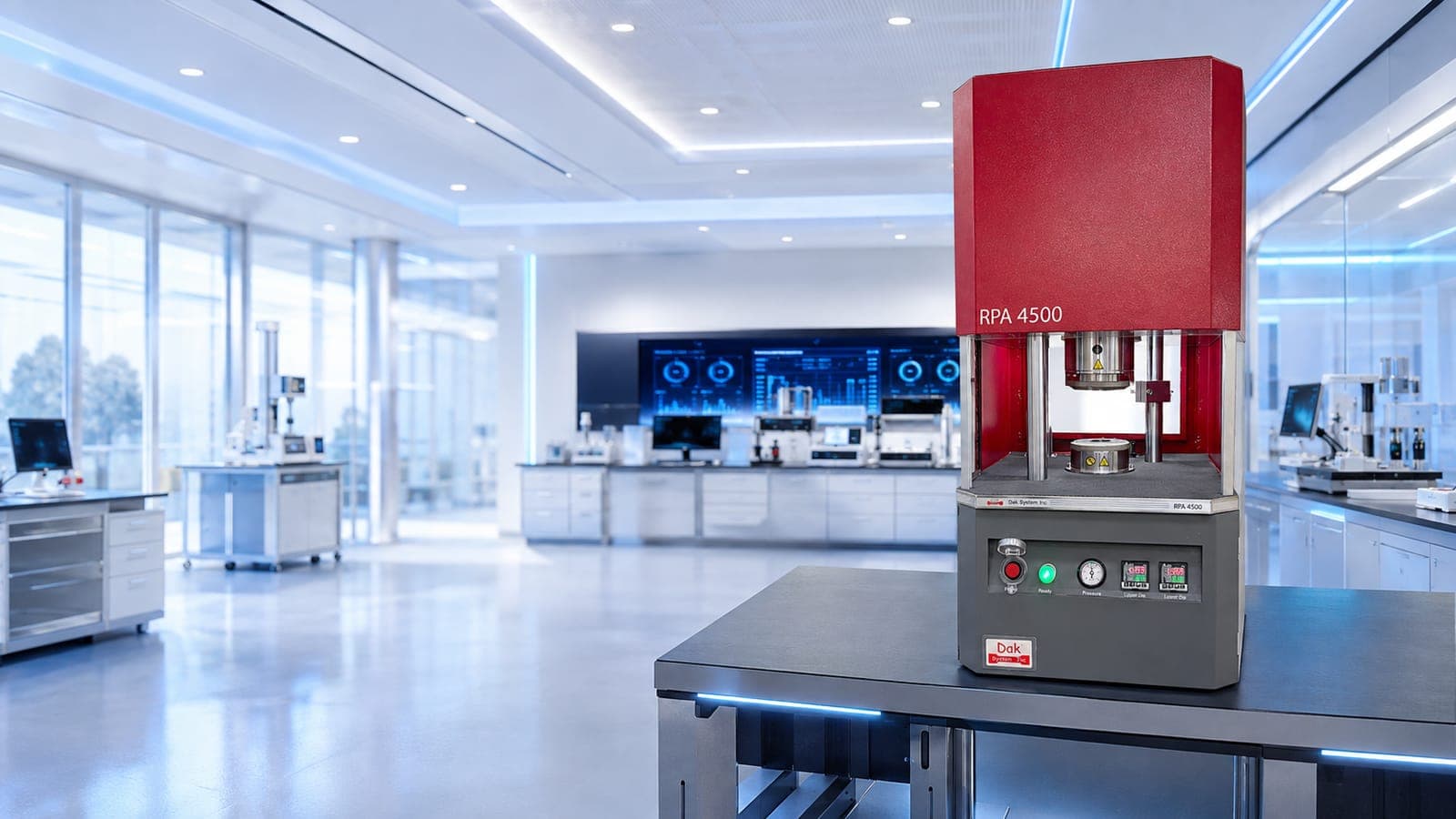
RPA
Rheology
Measures viscoelastic properties under variable strain, variable frequency and variable temperature in a sealed, pressurised cavity. One specimen, one loading, gives processability, cure characteristics and final cured properties.
- Oscillation
- 0.05 – 90° of arc
- Temperature
- upto230 °C
Engineered to a measurable standard.
- Torque range, Primero
- 0.001 – 20 N·m
- Torque range, Ultimo
- 0.0001 – 20 N·m
- Torque transducer
- Ultra-high stiffness
- Torque units
- dN·m, lbf·in, kgf·cm or N·m
- Oscillation angle, Primero
- ±0.1° – ±10° arc (1.4 – 100% strain), continuously variable
- Oscillation angle, Ultimo
- ±0.02° – ±90° arc (0.28 – 1256% strain), continuously variable
- Strain resolution
- 0.0003 arc degree
- Additional accuracy torque range
- Optional on the Ultimo
One sample, one loading, the whole story.
A sealed pressurised cavity, a direct drive that sets the angle in software, and a transducer sensitive enough to read an uncured gum.
Three variables, one test
Strain, frequency and temperature are all set by the test procedure, so before-cure, cure and post-cure properties come off one specimen in one loading.
Sealed pressurised cavity
In an unsealed cavity the specimen edge distorts at high strain and does not repeat. Here the sample is confined at the edge, so 1256% strain reproduces.
Direct drive, no spacers
The oscillation angle is set by the direct drive in software, not by fitting a spacer. Changing amplitude between tests triggers no re-calibration.
Load and go
A conventional tester needs the die gap set by hand until the sample touches both dies. Here the specimen is loaded and the surplus squeezes out by itself.
Non-isothermal cure
Programme the temperature profile a press actually gives, not an idealised isotherm. It carries 1.5 times the scorch sensitivity of the isothermal test.
Filler dispersion by strain sweep
Sweeping strain through the non-linear region measures the Payne effect directly, so filler loading and dispersion are read as numbers.
Raw polymer incoming QC
Two lots of SBR 1006 with the same Mooney viscosity separate cleanly on uncured tan delta, which a viscometer cannot see at all.
Portable console
Run tests and review results at the machine, or from a server shared by several instruments, so one PC is not tied to one bench.
Evidence your auditor and your buyer both accept.
Every method your customers specify, and every calibration standard your procurement team will be asked to document.
Built to run any published method
Rheological and viscoelastic characterisation of rubber — cure, dynamic properties and processing behaviour, to ASTM D5289, D6204 and D6601.
- ASTM
- ASTM D5289ASTM D6204ASTM D6601
Windows 11, 64-bit · full compliance matrix
Tell us what you need to test.
Send us the material and the standard it has to satisfy. Our engineers will specify the frame, the load cell and the fixturing.
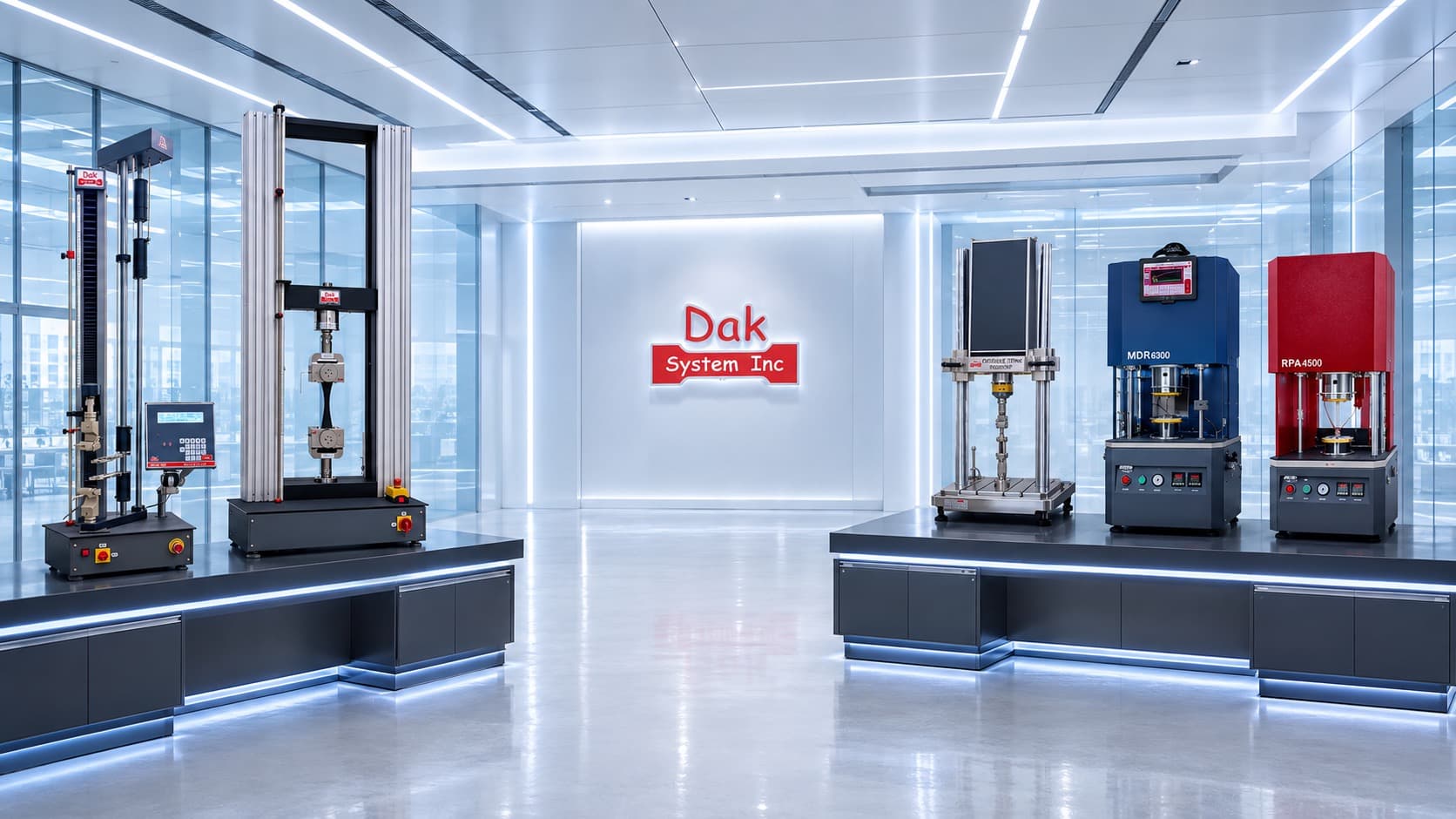
The RPA characterises a compound across strain, frequency and temperature. Where the work is routine cure testing to a fixed method, the MDR Elite-6300 does exactly that job and is built around the throughput it needs.